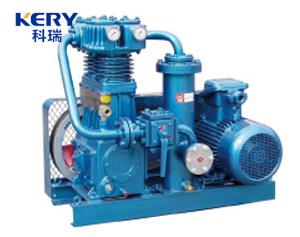
Compressor for loading and unloading vehicles
2023/6/8
Liquefied gas and C4 loading and unloading compressors

Inlet pressure:≤1.0MPa Discharge pressure:≤1.6MPa
Maximum pressure difference:0.6MPa Maximum instantaneous pressure ratio:≤6 Cooling method:air cooling
The unloading capacity is calculated based on an inlet pressure of 1.0MPa,an outlet pressure of 1.6MPa,an inlet temperature of 40℃,and a liquefied gas liquid density of 582.5Kg/㎡.When the working conditions change,the unloading capacity will change accordingly,for reference only.
Propylene loading and unloading compressor
进压:≤1.6MPa 排压:≤2.4MPa
最大压差:0.8MPa 最大瞬时压比:≤4 冷却方式:风冷
卸车量按进压1.6MPa,排压2.4MPa,进温40℃,丙烯液体密度614kg/m3计算,工况改变时,卸车量会随之改变,仅供参考。
液氨装车、卸车压缩机
Inlet pressure:≤1.6MPa Discharge pressure:≤2.4MPa
Maximum pressure difference:0.8MPa Maximum instantaneous pressure ratio:≤4 Cooling method:air cooling
The unloading capacity is calculated based on an inlet pressure of 1.6MPa,an outlet pressure of 2.4MPa,an inlet temperature of 40℃,and a liquid ammonia density of 729kg/m3.When the working conditions change,the unloading capacity will change accordingly,for reference only.
Loading and unloading truck compressor
Schematic diagram of unloading process flow
Liquid conveying
At the beginning,open the liquid phase pipe of the tank car for quality inspection in the storage tank.If the liquid level in the tank car is higher than the storage tank,it will automatically flow into the storage tank.When equilibrium is reached,the flow will stop.If the liquid phase of the tank car is lower than that of the storage tank,directly start the compressor,and the four-way valve is in the positive position.After the compressor extracts gas from the storage tank and pressurizes it,it is discharged into the tank car.At this time,the pressure inside the tank car increases,and the pressure inside the tank decreases.The liquid inside the tank car flows into the storage tank under the pressure difference.(As shown in the figure below)
Residual gas recovery
After unloading,there is some residual night and saturated gas left at the bottom of the tank car.When the user needs to recover this medium,the four-way valve should be reversed and the liquid phase pipeline should be closed.At this point,the remaining saturated gas in the tank car is sucked in by the compressor,pressurized and then directed towards the storage tank.The pressure inside the storage tank rises,exceeding the gas phase saturation pressure and causing the gas phase to liquefy,achieving the purpose of recovery.The pressure inside the tank car decreases,and the liquid phase in it will continue to gasify until the liquid has been gasified and the gas phase pressure drops to the maximum allowable value of the compressor's operating conditions before stopping recovery.(Note:When recovering residual gas,a cooler can be added at the exhaust end to facilitate recovery)
Working principle of four-way valve
Pull the handle of the four-way valve.When the four-way valve is in the position shown in Figure a,the A end is for intake,and the gas flows from A to B.Through the connecting pipe,the intake filter components,compressor intake pipe,compressor,compressor exhaust pipe,D end flows to C end,and C end is for exhaust end.
When the four-way valve is in position B in the figure,the C end is the intake,and the gas flows from the C end to the B end.It flows through the connecting pipe,intake filter components,compressor intake pipe,compressor,compressor exhaust pipe,and D end to the A end,and the A end is the exhaust end.
Reference Example for Selection and Calculation of Liquid Nitrogen Unloading Compressor
Compressor inlet and outlet pressure selection
Saturated vapor pressure of liquid nitrogen at 20-36℃
At higher temperatures,the saturated vapor pressure of liquid ammonia is relatively high,so the 16(inlet pressure)-24(exhaust pressure)model is selected to meet the usage environment at higher temperatures.
Compressor displacement calculation
The specific flow calculation is quite complex and needs to be determined based on calculation formulas and experience.This only introduces a simple calculation method.
Taking the unloading of a 15 ton tank truck in 1 hour as an example for calculation:
Calculate Tank Car Volume
Based on the provided working conditions,first determine the total volume flow rate required to unload 15 tons of liquid ammonia tank truck in 1 hour.
The specific gravity of liquid ammonia is 0.618,so the volume of 15 tons of liquid ammonia is:15÷0.618=24.272m3;Moreover,due to the fact that tank trucks are not allowed to be fully loaded,usually when loaded to around 80%of the tank truck's volume,the tank truck's volume is 24.272÷0.8=30.34,so the tank truck's volume is 30m3.
Calculate exhaust volume
Due to the fact that when unloading a compressor,a pressure difference must be established before liquid ammonia can be unloaded from the tank car to the storage tank.Generally,the time to establish the pressure difference is 15 minutes,so the actual unloading time is only 45 minutes,which means the required exhaust volume is 30÷45=0.66667m3/min.After the gas is pressurized from 16kg to 24kg by the compressor,the volume will decrease to about 0.66667%(16÷24)of the original volume.Therefore,the compressor exhaust volume is 0.66667÷0.66667=1m3/min
Based on the above calculations,it is recommended to choose the compressor model as ZW-1.1/16-24

Bengbu Kerui Compressor Co., Ltd 版权所有 皖ICP备16018486号 Disclaimer